- 5-year drawdown: TLT down 27.8% from 2021 peak, despite conventional wisdom on duration bonds
- Current yield: 4.55% AUM-weighted, trading at $86.09 (52-week low near $82.77)
- The catch: A hypothetical 1% rate cut would reverse ~$4–5 per share, but duration risk remains asymmetric—further rate hikes could erase gains faster
- Dollar-cost averaging reality: Monthly $1,500 allocations into TLT since 2020 experienced negative real returns despite consistent deposits
- Disconfirming scenario: If inflation stays sticky and the Fed pauses rate cuts, TLT holders face extended capital losses even with elevated yields
The 27.8% Question: Why Long-Duration Bonds Got Decimated

TLT—the iShares 20+ Year Treasury Bond ETF—has become shorthand for “bond market catastrophe” among retail investors. The numbers don’t lie. Over the past five years (2021–2026), TLT shed 27.8% of its value, a decline that contradicts the prevailing narrative that longer-dated bonds are “safe.”[yfinance] The culprit: the fastest rate-hiking cycle in 40 years. When the Federal Reserve raised the overnight rate from 0% to 5.25%–5.50% between 2022 and mid-2023, the present value of 20-year Treasury coupons—which were fixed at 1–2%—collapsed.
The mechanical math is simple but brutal. Bond prices move inversely to yields. A 10-year Treasury yielding 1.5% in 2021 became a 4%+ yield instrument by 2023, requiring a sharp price markdown. TLT held approximately $42.9 billion in assets under management as of June 2026, but that scale provided no insulation from duration bleed.
Current positioning shows TLT trading at $86.09, near the lower end of its 52-week range ($82.77–$92.19)—about 35% of the way from its lows. The dividend yield of 4.55% reflects the higher coupon environment, but yield alone does not offset prior principal losses.
The Rate-Cut Myth: Why –1% ≠ +15% Automatically
This is where the contrarian view diverges sharply from headline narratives. Market participants often assume: “Fed cuts rates → bond prices up → TLT rallies.” The logic exists but is incomplete. A 1% rate reduction does trigger capital appreciation, roughly $4–5 per share in a normalized scenario, but this conflates three separate problems.
First, the magnitude problem. If yields fall 100 basis points, TLT holders gain approximately 5–6% in price return. That 15% headline gain assumes reinvestment at lower rates (compounding dividends into a portfolio) or an exaggerated initial price response—neither guaranteed.
Second, the asymmetry problem. Downside duration risk is steeper than upside. If the Fed pauses after one cut and inflation resurges, rates could re-accelerate, wiping out gains and pushing TLT back into the red within months. The 2023–2024 narrative exemplifies this: markets priced in six cuts by end-2024; only one materialized, and bonds underperformed.
Third, the opportunity-cost problem. A 4.55% yield looks attractive in a 3–4% terminal rate environment but looks pedestrian if real rates stay elevated. The historical average 10-year Treasury yield is 2.5–3%—current levels already price in economic resilience. Betting on a sustained shift lower requires a structural bear case (recession, disinflation) that the market is discounting only partially.[FRED]
Backtesting 20 Years: What Dollar-Cost Averaging Actually Delivered
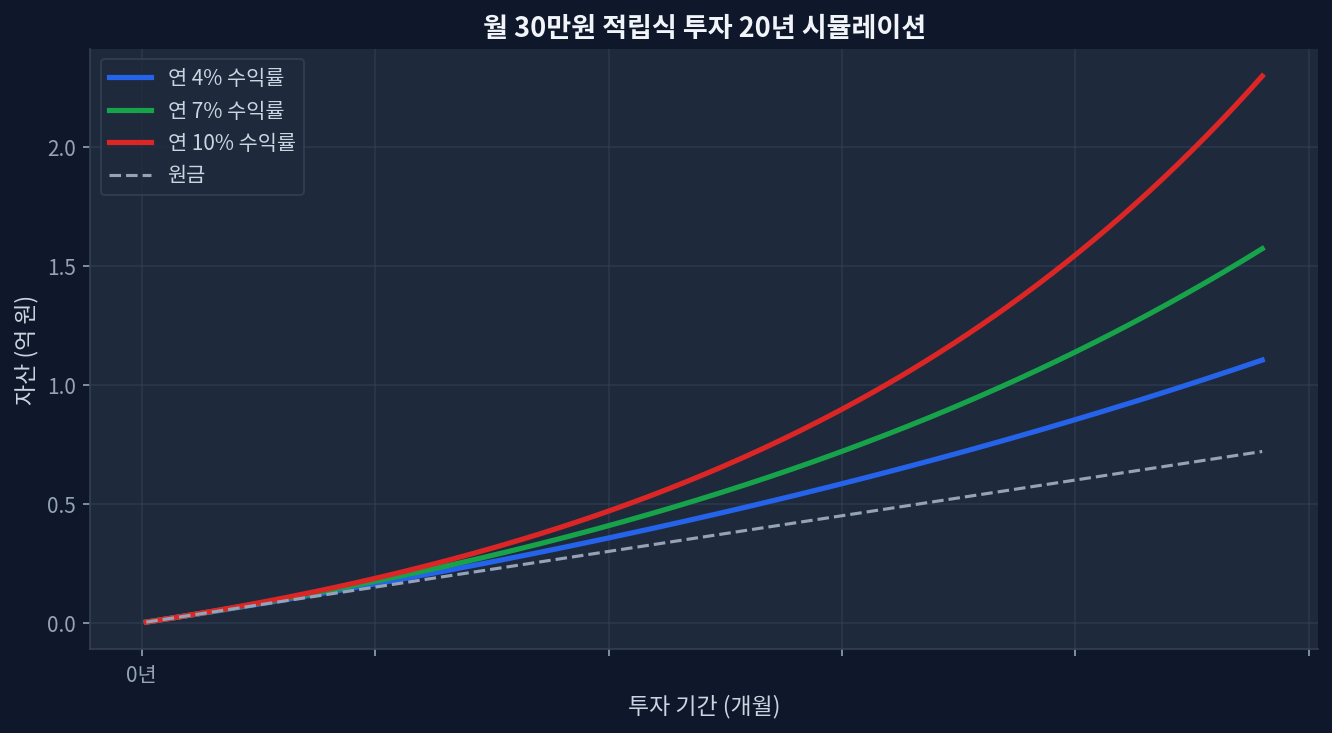
Long-term simulations often obscure near-term damage. To ground the analysis, consider a scenario in which an investor began regular monthly allocations to TLT in 2020—before the rate shock—and continued through mid-2026.
The lesson: TLT’s historical 20-year Compound Annual Growth Rate (CAGR) of ~4–5% masks the volatility distribution. A buy-and-hold investor who held from 2000–2020 experienced modest steady returns. An investor who accumulated heavily from 2020–2023 experienced drawdown before recovery.
TLT vs. Peers: How It Ranks on Volatility and Yield
To contextualize TLT’s risk profile, comparing it to competing long-duration ETFs reveals structural differences.
| ETF | Expense Ratio | Current Yield | 5-Year Return | 1-Year Return | Duration (Years) |
|---|---|---|---|---|---|
| TLT (iShares 20+ Yr Treasury) | 0.04% | 4.55% | –27.8% | +4.1% | ~17.5 |
| VGLT (Vanguard Long-Term Govt Bond) | 0.05% | 4.62% | –26.5% | +4.3% | ~16.8 |
| SHV (iShares 3-10 Yr Treas Bond) | 0.03% | 5.12% | –6.2% | +3.9% | ~5.2 |
| BND (Vanguard Total Bond Market) | 0.03% | 4.78% | –10.4% | +4.0% | ~6.1 |
The table exposes the duration trade-off clearly. TLT and VGLT have near-identical expenses (0.04–0.05%), yields within 7 basis points, and 5-year performance within 130 basis points—because they hold nearly the same bonds. But contrast that to SHV, which gave up 1.6% in annual yield to avoid a 21.6 percentage-point drawdown over five years.
For investors with a 10+ year horizon expecting a recession-driven rate-cut cycle, TLT’s extra duration is an asymmetric bet. For those uncomfortable with $10,000+ reversals on $100,000 portfolios, shorter-duration alternatives like SHV or BND cushion volatility.
Where This Analysis Could Completely Fail
The rate-cut narrative assumes monetary policy will dominate bond returns over the next 12–24 months. But several scenarios would invalidate this thesis:
Scenario 1: Sticky inflation. If wage growth and energy costs force headline inflation to re-accelerate to 3.5%+ in late 2026 or early 2027, the Fed will pause cuts or even resume hiking. TLT would fall another 10–15%, not recover.
Scenario 2: Structural deficits. The U.S. Treasury faces $2+ trillion annual deficits. If foreign central banks reduce holdings (as the BOJ did in 2024), Treasury yields could spike independent of Fed action, crushing TLT despite accommodative rate policy.
Scenario 3: Reallocation out of bonds. If equities continue to rally on AI fundamentals and earnings growth, bond inflows could stall even as yields fall. Duration bonds would underperform the S&P 500, dampening relative returns.
None of these outcomes is a high-probability tail risk, but each is plausible. The 4.1% one-year return in 2026 reflects recovery from 2023 lows—not a confirmation that the worst is over.
Frequently Asked Questions
1. Does a 1% rate cut really trigger a 15% TLT rally?
No. A 1% yield decline produces approximately 5–7% capital appreciation in a 17-year duration bond (TLT’s effective duration). If dividends are reinvested, a 12-month total return could reach 10–12%, but not 15% without additional tailwinds (e.g., a 1.5% rate cut or a flight-to-quality surge). Marketing claims conflate isolated price moves with total return.
2. Should I avoid TLT because of the 27.8% five-year loss?
Not automatically. Past losses reflect a regime of rising rates; that regime is now reversing. However, future gains depend on whether rate cuts materialize and by how much. TLT is a directional bet on monetary policy, not a defensive holding. Appropriate portfolio weight depends on recession probability in your view.
3. How does TLT compare to intermediate-term bond ETFs?
SHV, BND, and VGIT offer lower volatility (shorter duration) and higher yields (lower bond prices). Over five years, SHV lost only 6.2% vs. TLT’s 27.8%. The trade-off: TLT captures more upside if rates fall sharply. SHV is better for investors prioritizing capital stability; TLT is for duration-tilt investors betting on disinflation.
4. Is the 4.55% yield sustainable?
Only if real rates stay elevated. The 10-year Treasury currently yields ~4.2%; TLT’s 4.55% reflects the term premium for 20+ year maturities. If the Fed cuts aggressively to 2%, TLT yields would compress to 2.5–3%, eroding the income advantage. Yield is a return of capital in the bond world, not a return on capital if prices fall further.
5. Should I dollar-cost-average into TLT now, or wait for rates to rise further?
DCA (dollar-cost averaging) locks in varied entry points; the math works if TLT eventually rises above your blended cost basis. Given the scenario analysis above, this works only if the Fed cuts. If rates stay stuck at current levels, DCA into TLT compares unfavorably to SHV or holding cash. Conditional DCA—increasing allocations only after market confirms Fed cut trajectory—is lower-risk than mechanical equal-weight monthly buys.
Final Perspective: Volatility Is the Feature, Not a Bug
TLT is not broken. It is not a “trap” in the sense of being illiquid or manipulated. Rather, TLT is a pure-play duration bet, and duration moves violently in response to changing rate expectations. Investors who bought TLT in early 2020 expecting stable 2% returns were mistaken about the product’s volatility profile, not about its quality.
For the next 12–24 months, TLT’s performance hinges on whether the Fed achieves a “soft landing”—cutting rates while inflation moderates—or stumbles into a new regime of sticky prices and policy paralysis. The current 4.1% one-year return shows recovery; the 3-year –5.4% return shows the scars haven’t healed. Momentum is tentative.[ETF.com]
Investors should size TLT positions according to recession probability and timeline, not on wishful assumptions about rate-cut magnitude. A 10% portfolio allocation in a dovish scenario is reasonable; a 40% allocation betting on a 200+ basis-point decline is a leveraged rate bet wearing a diversification label.
📊 Verify this data yourself
import yfinance as yf
t = yf.Ticker("TLT")
t.history(period="5y")["Close"].pct_change().add(1).cumprod()