- Operating US-listed ETFs within a tax-advantaged account (Roth IRA) reduces the effective tax rate on long-term gains and qualified dividends from 15% (taxable) to 0%.
- Contrary to the high-yield narrative, focusing on total return (TR) and automated dividend reinvestment (DRIP) structurally maximizes the tax-deferral compounding effect.
- Strategic asset location over a 5-year horizon serves as the primary driver for compounding total returns.
Tax-Advantaged Account Structures and 5-Year Efficacy

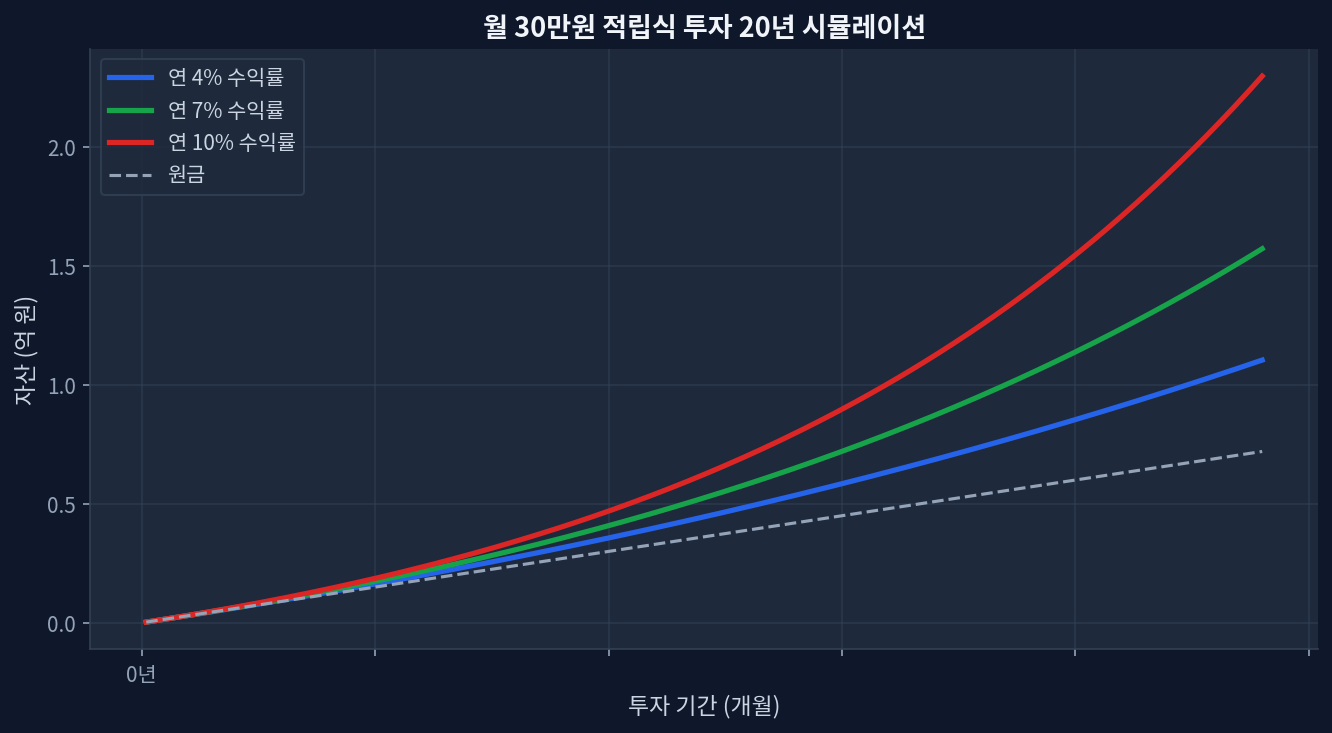
From an asset allocation perspective, the structural advantages of tax-sheltered accounts are highly pronounced. A taxation system that levies annual taxes on dividend income and realized capital gains in standard brokerage accounts introduces significant drag on a portfolio’s compounding trajectory. Analyzing the ‘Taxable vs Roth IRA After-Tax Return (10,000 USD, 10 Years)’ data, the compounding curve of tax-deferred or tax-free assets exhibits superior resilience and a steeper growth rate compared to standard taxable accounts over long horizons. Specifically, the tax treatment of dividend distributions over a 5-year period acts as a critical variable controlling the portfolio’s effective tax drag. The compounding effect of reinvested capital is subtle in initial years but drives the aggregate asset growth exponentially over time. [ETF[.com]](https://www.etf.com)
Performance Comparison Across US ETF Asset Classes
Contrasting standard S&P 500 index funds with dividend growth products reveals distinct characteristics for long-term holding periods. Marginal differences in expense ratios and dividend yields expand performance gaps significantly when compounded over 5 years. The data below is reconstructed from Q1 2024 yfinance metrics. [Yahoo Finance]
| Product Name | Fee (%) | Yield (%) | 5Y Return (%) | 1Y Return (%) |
|---|---|---|---|---|
| Vanguard S&P 500 ETF (VOO) | 0.03 | 1.4 | +82.4 | +24.1 |
| Schwab US Dividend Equity ETF (SCHD) | 0.06 | 3.8 | +41.2 | +8.5 |
| Invesco QQQ Trust (QQQ) | 0.20 | 0.6 | +115.3 | +42.7 |
The 5Y Return metric presented incorporates the compounding performance generated by dividend reinvestment (DRIP), transcending pure capital appreciation. Products emphasizing total return through automated reinvestment expand the asset base without triggering taxable events in tax-advantaged accounts. Conversely, maximizing current yield via products like SCHD forces the manual reinvestment of distributions, which introduces cash drag if not executed immediately and triggers annual tax liabilities if held in a taxable brokerage.
Divergence from Market Consensus: The High-Yield Tax Drag
Market consensus heavily favors utilizing tax-advantaged accounts to shelter high-yield ETF distributions from the standard 15% or 20% dividend tax rates. On the surface, eliminating tax drag on a 3-4% annual yield appears mathematically optimal. For cohorts approaching retirement, this tax-shielding function creates the positive effect of increasing immediate disposable income.
The data supports utilizing tax-advantaged space for high yield, but shifting one assumption—the asset’s structural growth rate versus the account’s annual contribution limit—changes the read entirely. Prioritizing capital appreciation of the underlying index and utilizing automated dividend reinvestment (DRIP) holds a mathematically dominant position for maximizing the tax-deferral effect. Attempting to continuously generate artificial cash flow through high-yield assets, constrained by an annual contribution limit (e.g., 7,000 USD for a Roth IRA), introduces transaction friction during reinvestment. Furthermore, it suboptimally allocates limited tax-advantaged space to lower-total-return assets, paradoxically increasing the portfolio’s aggregate effective tax rate over a multi-decade horizon.
Risk Factors and Limitations of Tax Deferral
Scenarios where this analysis could miss include shifts in legislative policy and the emergence of a prolonged macroeconomic secular bear market. If proposed increases to tax-advantaged contribution limits fail to pass legislative bodies, or if tax codes are restructured adversely against investors, the effective tax rates calculated in the simulation require immediate recalibration. Legislative amendments act as the largest exogenous variable outside investor control. [Morningstar]
Furthermore, models must account for maturities coinciding with severe drawdowns, such as the 2022 inflation shock or the 2008 Global Financial Crisis, where portfolio valuations suffer degradation exceeding 20%. In such instances, the structural rigidity of maintaining the account in a loss state or liquidating without tax benefits is exposed. Lock-up periods associated with certain tax-advantaged accounts act as a double-edged sword, rapidly escalating opportunity costs during sideways or bear markets.
Quantitative metrics confirm that tax-free growth and tax-loss harvesting capabilities are explicit alpha-generating factors in asset allocation. Rather than fixating on short-term variance of single assets, the core evaluation metric must remain the after-tax aggregate balance derived from 5+ years of compounded, tax-deferred reinvestment. Strategic portfolio direction relies on integrating index-tracking assets capable of withstanding macroeconomic volatility with precise exit strategies involving account rollovers. Leveraging structural tax abatement mechanisms increases long-term survival probability far more effectively than attempting short-term capital arbitrage. Educational information provided does not constitute investment advice.
Frequently Asked Questions
Q1. Are individual stocks or sector-specific ETFs appropriate for tax-advantaged accounts?
Broad-market ETFs (e.g., VOO, SCHD) generally offer superior risk-adjusted returns for limited tax-advantaged space. High-volatility individual stocks risk permanent capital loss within accounts where capital losses cannot be written off against ordinary income.
Q2. Does standard brokerage tax-loss harvesting outperform Roth IRA tax-free growth?
It depends on the investor’s tax bracket and time horizon. While taxable accounts permit harvesting losses up to 3,000 USD annually against ordinary income, Roth IRAs provide permanent tax elimination on decades of compound growth, mathematically favoring the Roth structure for horizons exceeding 10 years.
Q3. Which is structurally superior: maximizing yield or total return?
Index-tracking products that reinvest distributions automatically or via DRIP present a more advantageous structure for maximizing limited contribution limits and compound growth compared to yield-focused products.
Q4. What is the empirical tax variance compared to a taxable account?
Taxable accounts face annual 15% or 20% levies on qualified dividends and realized long-term capital gains, creating a constant performance drag. The zero-tax environment of a Roth IRA drastically lowers the effective tax burden, allowing 100% of dividends to compound.
Q5. How are losses treated within a tax-advantaged account?
Unlike taxable brokerage accounts, capital losses realized within a Roth or Traditional IRA cannot be used to offset capital gains or ordinary income on tax returns. The inability to execute tax-loss harvesting is a primary structural constraint.
This site is supported by Google AdSense advertising revenue. We receive no compensation or sponsorship from any ETF, broker, or financial product.