- JEPQ's recent quarterly dividend was $0.5910 per share, marking a 2.6% increase year-over-year.
- JEPQ has shown strong short- to medium-term performance with a 1-year return of +27.4% and a 3-year cumulative return of +79.1%, closely tied to the volatility of its underlying asset, the Nasdaq 100 index.
- Its current dividend yield is 10.35%, but this largely depends on option premium income due to the nature of the covered call strategy, implying inherent dividend variability based on market conditions.
- Comparative analysis with JEPI shows JEPQ recording higher returns and dividend yields, attributable to differing exposure to technology-driven growth momentum.
- The attractive yields of high-dividend covered call ETFs come with risks, including vulnerability to price declines during market downturns and the potential for unexpected dividend cuts.
JEPQ Quarterly Dividend Announcement Analysis: Returns and Volatility Perspective

JEPQ recently announced a quarterly dividend of $0.5910 per share, drawing investor attention. This 2.6% year-over-year increase underscores the appeal of covered call ETFs that pursue both growth and income. Currently, JEPQ’s share price stands at $59.66, with a dividend yield of 10.35%, an attractive figure for those seeking high-yield investments. However, a deeper analysis is warranted regarding the stock price volatility accompanying such high dividend yields and the sustainability of these returns.
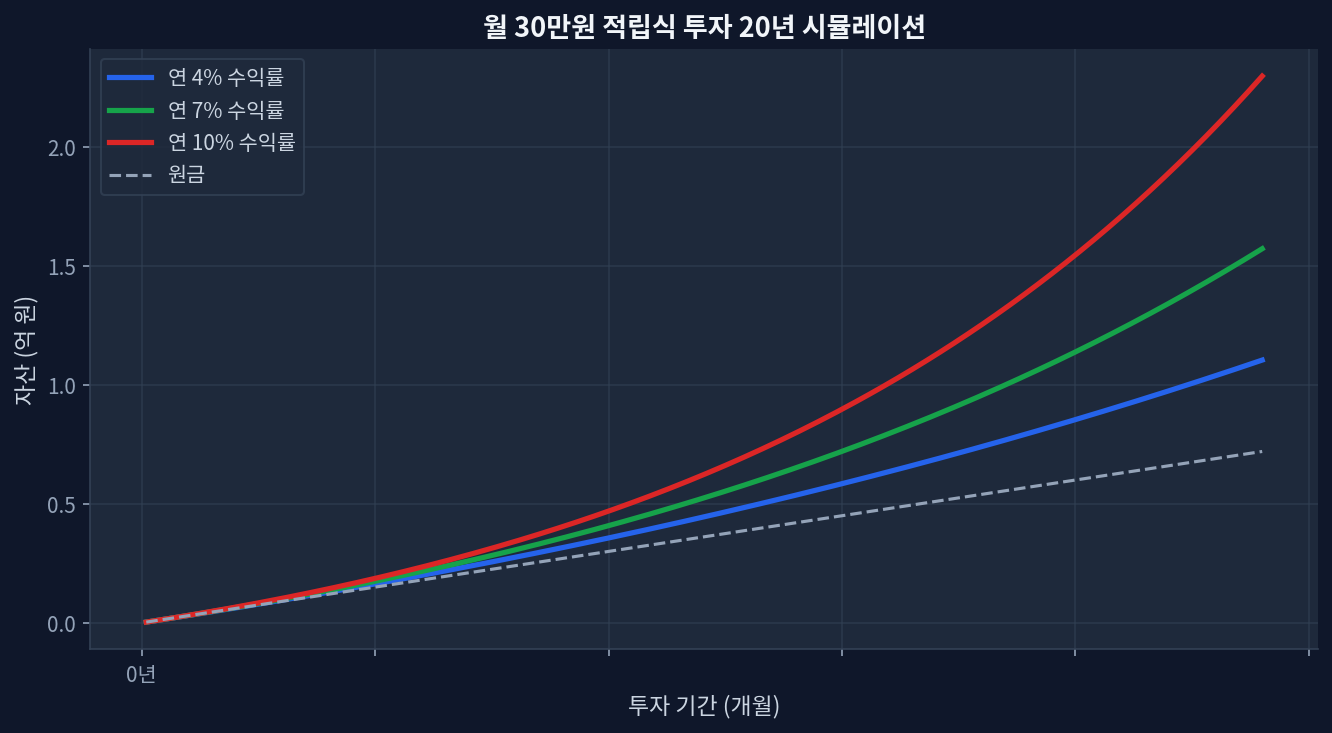
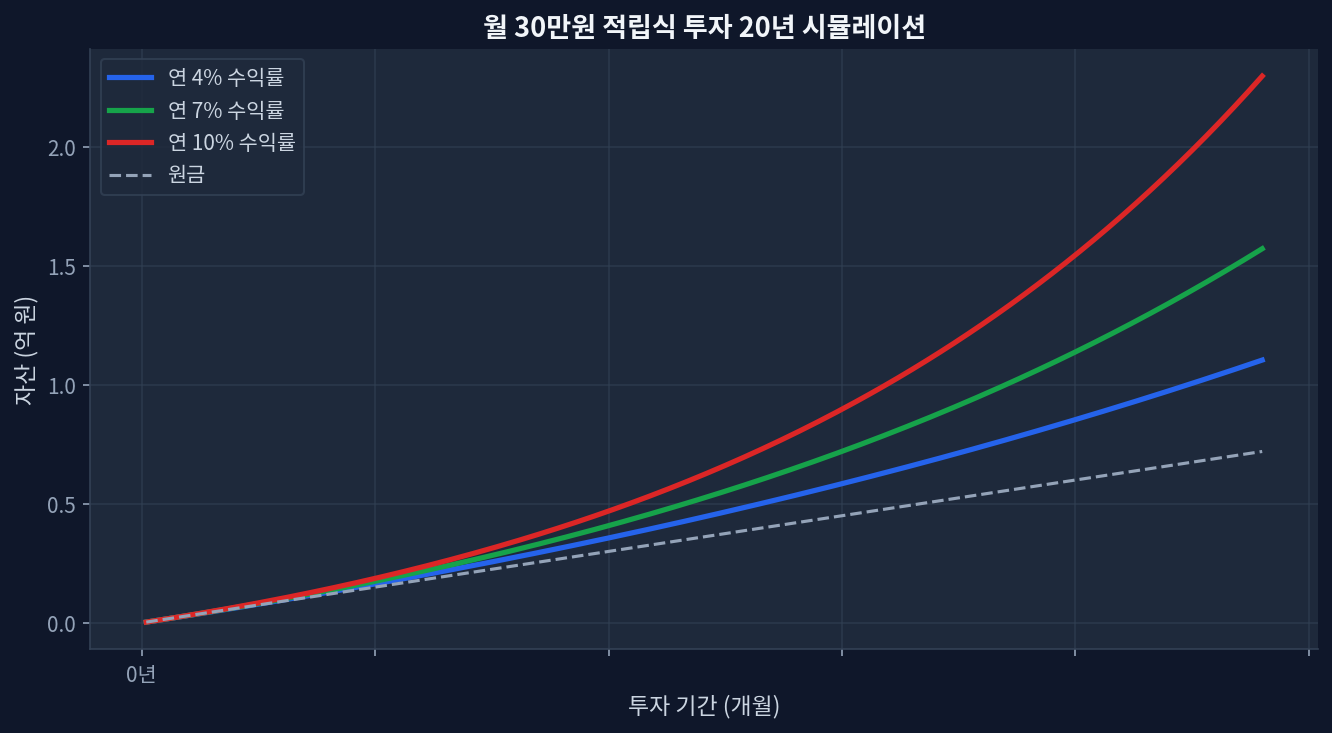
JEPQ has recorded impressive returns of +27.4% over the past year and a cumulative +79.1% over three years. This performance is attributed to the combined effect of the Nasdaq 100 index’s upward momentum and option premium income generated through its covered call strategy. However, it is crucial not to overlook that such high returns tend to be more pronounced during bull markets, with potentially limited defensive capabilities during downturns. The simulation chart below illustrates how long-term asset accumulation curves vary with annual compound returns in a dollar-cost averaging strategy, serving as an important reference point for evaluating the actual contribution of high-dividend ETFs like JEPQ.
Understanding Covered Call Strategies Through Comparison with JEPI
In the high-dividend covered call ETFs market, JEPI serves as a primary comparative benchmark for JEPQ. Both ETFs employ similar covered call strategies but differ in their underlying assets and portfolio composition. While JEPQ tracks the Nasdaq 100 index, JEPI invests in S&P 500 index components. This distinction directly impacts the return and volatility characteristics of both ETFs. The following table compares key metrics for the two ETFs.
| Product Name | Expense Ratio | Dividend Yield | 1-Year Return | 3-Year Cumulative Return | 5-Year Cumulative Return |
|---|---|---|---|---|---|
| JEPQ | 0.35% | 10.35% | +27.4% | +79.1% | N/A |
| JEPI | 0.35% | 8.29% | +8.4% | +29.8% | +44.3% |
As observed in the table, JEPQ demonstrated superior performance over JEPI in both 1-year and 3-year cumulative returns. This is primarily due to the Nasdaq 100 index experiencing robust technology-driven growth over the past few years. Conversely, JEPI exhibited relatively more moderate returns, based on the comparatively stable movements of the S&P 500 index. JEPQ also shows a higher dividend yield compared to JEPI. However, these elevated returns must be interpreted alongside the potential for increased volatility driven by changing market conditions. The high growth potential of the Nasdaq 100 simultaneously carries significant volatility risk [Source: ETF.com].
JEPQ Dividend Growth Rate and Market Consensus Evaluation
JEPQ’s 2.6% quarterly dividend increase may appear as a positive signal; however, the real purchasing power gain, when compared against inflation rates, requires careful evaluation. Furthermore, dividends from covered call strategy-based ETFs heavily rely on option premium income. Consequently, there is always a possibility of reduced dividends during periods of diminished market volatility or an overall stock market downturn. Should the technology-driven bull market that persisted since 2020 abate, the historical dividend growth rates may not guarantee future performance, presenting a clear risk factor.
Market consensus typically assigns high expected returns to growth-oriented ETFs. However, in JEPQ’s case, while the option selling strategy limits full participation in market upside, it simultaneously provides a partial defensive buffer during declines. Therefore, the trajectory of Nasdaq 100’s expected market direction and JEPQ’s actual dividend growth and total returns may diverge. A key scenario where this analysis could be inaccurate is during prolonged periods of extremely low market volatility. In such an environment, reduced option premium income could diminish the appeal of dividends [Source: Yahoo Finance].
Risk Factors to Consider When Investing in JEPQ
While covered call ETFs like JEPQ aim for high dividends, a thorough understanding of their inherent risks is crucial. First, there is the risk of limited upside potential. The covered call strategy involves exchanging potential stock price appreciation for option premium income; thus, investors may not fully benefit from significant increases in the underlying asset’s price. Second, there are limitations to downside protection during market declines. While option selling offers some degree of downside buffering, a sharp market downturn can lead to price declines similar to those of the underlying asset. Third, dividend volatility is a factor. Option premiums fluctuate significantly with market volatility, meaning JEPQ’s monthly or quarterly dividends may not be consistent. Fourth, tax implications exist. For US investors, dividends from ETFs are generally subject to ordinary income tax rates, or qualified dividend tax rates depending on holding period and source. It is advisable to consult a tax professional regarding specific tax obligations. Finally, JEPQ is a relatively new ETF, and therefore, performance data across diverse market environments over an extended period remains limited, a factor that should be considered.
JEPQ Portfolio Inclusion: The Importance of Risk Management
JEPQ’s recent quarterly dividend increase and high returns are undeniably attractive elements. However, prior to making investment decisions, a comprehensive understanding of the structural characteristics and inherent risks of covered call ETFs is imperative. JEPQ can serve as a valuable tool for investors seeking to generate cash flow through high dividends, but it may not be suitable for those whose sole objective is long-term capital appreciation. Considering portfolio diversification effects and aligning JEPQ’s allocation with one’s investment objectives and risk tolerance is crucial. Especially when market volatility increases or negative outlooks for the technology sector emerge, investors should be aware that JEPQ’s dividends and share price could experience unexpected impacts. Scenarios where this analysis could prove incorrect include a prolonged downturn in the technology stock market or a sharper-than-anticipated decline in option premiums.
Frequently Asked Questions
Q1: What investment strategy does JEPQ employ?
A1: JEPQ invests in Nasdaq 100 index components and simultaneously sells call options on that index (covered calls) to generate option premium income. This strategy aims for high dividend returns.

Q2: What are the main differences between JEPQ and JEPI?
A2: Both ETFs utilize a covered call strategy, but JEPQ uses the Nasdaq 100 index as its underlying asset, whereas JEPI uses the S&P 500 index. Consequently, JEPQ tends to exhibit higher technology-driven growth and volatility, while JEPI leans towards the stability of large-cap stocks.

Q3: Are JEPQ's dividends consistent each month?
A3: JEPQ distributes monthly income, but the amount is not consistent each month. It can fluctuate due to various factors, including option premium income, movements in the underlying asset's stock price, and market volatility.

Q4: What are the most significant risks to be aware of when investing in JEPQ?
A4: Key risks include limited participation in stock price appreciation, limitations to downside protection during sharp market declines, dividend volatility, and the high volatility of its underlying asset, the Nasdaq 100. A thorough understanding of these inherent risks behind the high dividends is essential.

Q5: Is JEPQ suitable for long-term investment?
A5: While JEPQ is advantageous for generating cash flow through high dividends, its covered call strategy may result in lower long-term capital appreciation compared to typical growth stock ETFs. Therefore, it may not be suitable for investors whose primary goal is long-term capital growth, and its role and weighting within a portfolio should be carefully considered.
📊 How to verify this data directly
import yfinance as yf
t = yf.Ticker("JEPQ")
t.history(period="5y")["Close"].pct_change().add(1).cumprod()
This site is supported by Google AdSense advertising revenue. We receive no compensation or sponsorship from any ETF, broker, or financial product.