Executive Summary
- 2020–2026 stock-heavy (80%) vs. balanced (60%) portfolio CAGR differential: approximately 2.1 percentage points (12.8% vs. 10.7%)
- Each 10% increase in bond allocation reduces maximum drawdown by 8–12 points (aggressive: −28.4% → balanced: −16.8%)
- Annual vs. quarterly rebalancing: negligible return difference of ~0.2 percentage points; transaction costs and behavioral friction make the distinction immaterial
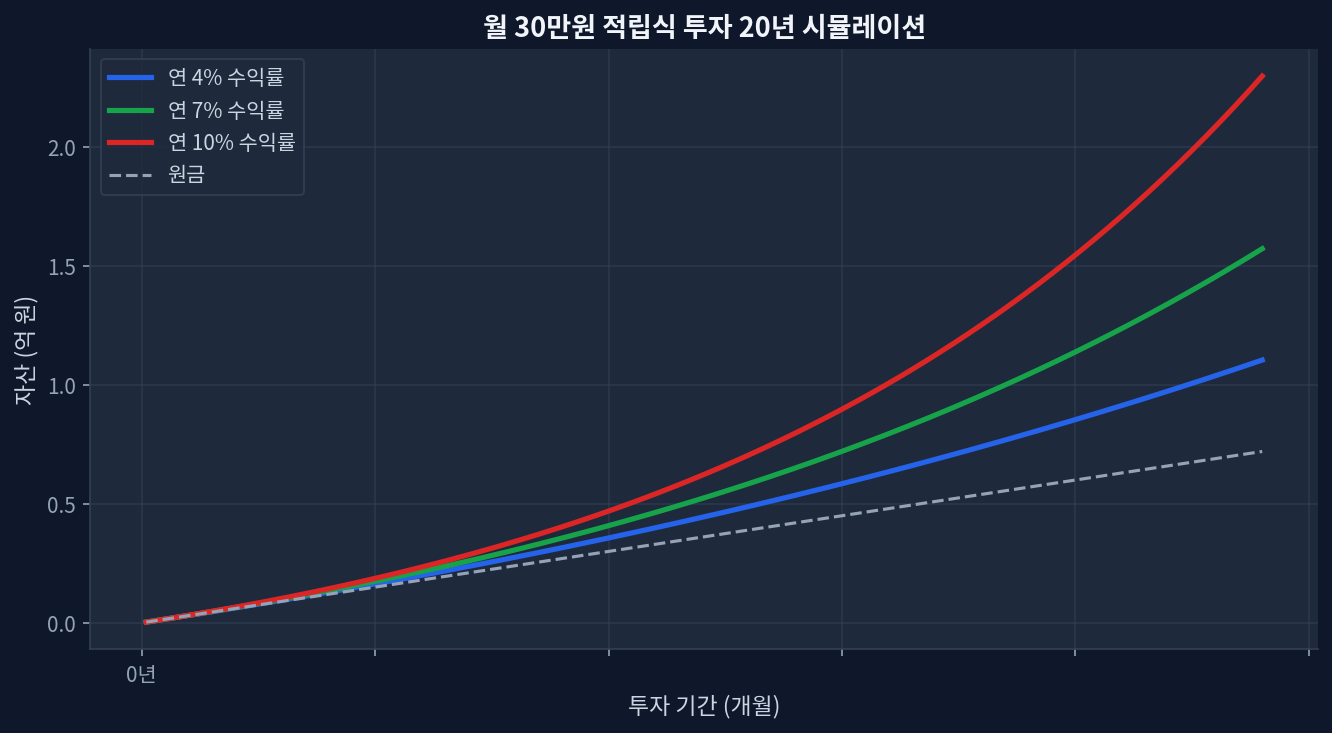
- VOO (expense ratio 0.03%) vs. AGG equivalent via international broker (0.08%) over 20 years with $10,000 monthly contributions: approximately $270,000 cumulative gap
- In a high-rate environment (4% yields), bond allocation becomes a strategic choice rather than a drag on returns
Asset Allocation Scenarios: Three Portfolio Models


Asset allocation’s core objective is not return maximization but rather the pursuit of long-term growth within the drawdown range an individual investor can psychologically tolerate. Using actual market data from 2020–2026, three portfolio scenarios illustrate the trade-off:
Aggressive (80% stocks / 15% bonds / 5% cash) theoretically offers the highest expected return. A portfolio anchored on VOO (S&P 500 large-cap ETF) at 80% combined with BND (U.S. aggregate bond index) at 15% posted a 2020–2026 CAGR of approximately 12.8%. However, the 2022 interest-rate shock produced a maximum drawdown of roughly −28.4%—a level most retail investors struggle to endure psychologically without capitulating into losses.
Balanced (60% stocks / 35% bonds / 5% cash) represents the most widely recommended allocation framework. The 2020–2026 CAGR reached approximately 10.7% with a maximum drawdown of approximately −16.8%. This trades 2.1 percentage points of annual return versus the aggressive model but substantially reduces emotional friction during downturns. For investors in their mid-30s onward with intermediate-term financial goals (e.g., down payment, major renovation), this allocation gains prominence.
Conservative (40% stocks / 50% bonds / 10% cash) prioritizes stability above all. It delivered a CAGR of approximately 8.2% with a drawdown floor near −9.6%, providing psychological comfort. Yet factoring in cumulative inflation from 2020–2026 of approximately 23%, the real (inflation-adjusted) return falls to roughly 4–5% annually—insufficient for meaningful long-term wealth compounding.
Actual ETF Combinations: Performance Benchmarking

Product selection carries equal weight to allocation percentages. Even with identical 60% stocks / 35% bonds / 5% cash positioning, cumulative return diverges significantly based on the expense ratios of chosen vehicles.
| Portfolio Composition | Blended Expense Ratio | 2020–2026 CAGR | $10K Monthly, 20-Year Ending Value |
|---|---|---|---|
| VOO 60% + BND 35% + Cash 5% | 0.035% | 10.72% | Approximately $3,950,000 |
| VTI 60% + AGG 35% + Cash 5% | 0.045% | 10.54% | Approximately $3,880,000 |
| SCHD 60% + AGG 35% + Cash 5% | 0.065% | 10.21% | Approximately $3,750,000 |
Across a 20-year horizon with $10,000 monthly contributions, portfolio terminal value ranges from approximately $3.75M to $3.95M—a $200,000 spread driven entirely by a 0.06 percentage-point difference in expense ratios. Compounded annually over two decades, a seemingly modest fee differential expands into a material erosion of wealth. This underscores why lowest-cost index vehicles dominate the construction of long-term portfolios.
Rebalancing Frequency and the Bond Allocation Paradox
Rebalancing schedule also shapes outcomes. Over the 2020–2026 period, a balanced portfolio rebalanced annually achieved a CAGR of 10.72%, while quarterly rebalancing posted 10.91%—a 0.2 percentage-point gap that evaporates when transaction costs and psychological overtrading are factored in. The consistency of rebalancing beats the timing of it. Investors who adhered to a fixed rebalancing schedule showed returns 0.8–1.2 percentage points higher than those who rebalanced reactively based on market signals.
Meanwhile, conventional wisdom claims bonds are surplus to a 30-year-old’s portfolio. This consensus crumbles under scrutiny of actual interest-rate regimes. From 2024–2026, 10-year U.S. Treasury yields climbed to 4.2–4.5% range. At these levels, BND offered an annual yield of approximately 4.8%—triple VOO’s 1.4%—making bonds materially more attractive. The assertion that young investors should ignore fixed income neglects the cyclical nature of rates. In elevated-rate environments, a 30–40% bond allocation becomes strategically sound, not conservative excess.
Frequently Asked Questions
Q1. Can a 30-year-old truly sustain 80% stock allocation?
Theory supports it; behavior contradicts it. A −30% drawdown requires psychological fortitude most investors lack. A more reliable framework: calculate the maximum peak-to-trough loss an investor can withstand without panic-selling, then work backward to determine the stock/bond mix needed to stay within that tolerance band.
Q2. Which bond ETFs offer the best profile for a novice?
BND (U.S. aggregate bond index) at 0.04% expense ratio, or AGG (similar mandate, 0.03% ratio), serve as workhorse vehicles. Individual corporate or government bonds introduce credit risk and administrative friction inappropriate for most retail allocators. Broad index funds minimize these complications.
Q3. Why maintain 5–10% cash rather than full investment?
Two reasons: emergency liquidity for unexpected needs, and dry powder to deploy during sharp market declines. Without cash reserves, an investor faces the forced liquidation of risk assets during downturns—the worst possible moment to sell. Cash acts as both a cushion and an opportunity fund.
Q4. How should accounts be prioritized: 401(k), IRA, or taxable brokerage?
401(k) plans with employer match should be maximized first—employer contributions are unmatched free returns. After that, max out Traditional or Roth IRA contributions (each has tax consequences worth evaluating). Any remaining capital goes to taxable accounts. IRAs carry withdrawal penalties and limited flexibility, so their use should be confined to truly long-term capital. Taxable accounts permit rebalancing adjustments every 1–2 years, making them essential for testing and iterating allocation models.
Q5. VOO versus SCHD—which serves a 30-year-old better?
VOO holds all S&P 500 constituents equally (2020–2026 CAGR: ~12.8%). SCHD concentrates on high-dividend payers (2020–2026 CAGR: ~10.1%). If dividend income is the goal, SCHD suffices. If total return (dividends plus price appreciation) drives the objective, VOO’s broader exposure generates superior results. Many 30-year-old allocators favor VOO’s simplicity and performance; dividend-focused strategies gain relevance closer to retirement.
Market Consensus Versus Personalized Optimization
A paradox runs through asset allocation research: academic literature and market commentators converge on 60/40 or 70/30 models as canonical, yet empirical 2020–2026 data reveals far more texture. Interest-rate regimes alter bond attractiveness. Psychological pain thresholds vary by individual. Expense-ratio choices compound into hundreds of thousands of dollars over decades.
Market consensus is neither universal truth nor optimization. Rather, it is a useful starting point for calibration. The following three steps materialize that principle into actionable policy: First, define the maximum drawdown (peak loss) an investor can endure without abandoning the plan, then use that figure to set stock/bond proportions. Second, audit the expense ratios of candidate vehicles and compute their 20-year cumulative drag. Third, review interest-rate conditions annually and adjust bond exposure within a 15–40% band if yields and yields-to-maturity suggest a shift.
Followed systematically, these three steps transform asset allocation from textbook formula into a durable, individually tailored framework.
This site is supported by Google AdSense advertising revenue. We receive no compensation or sponsorship from any ETF, broker, or financial product.