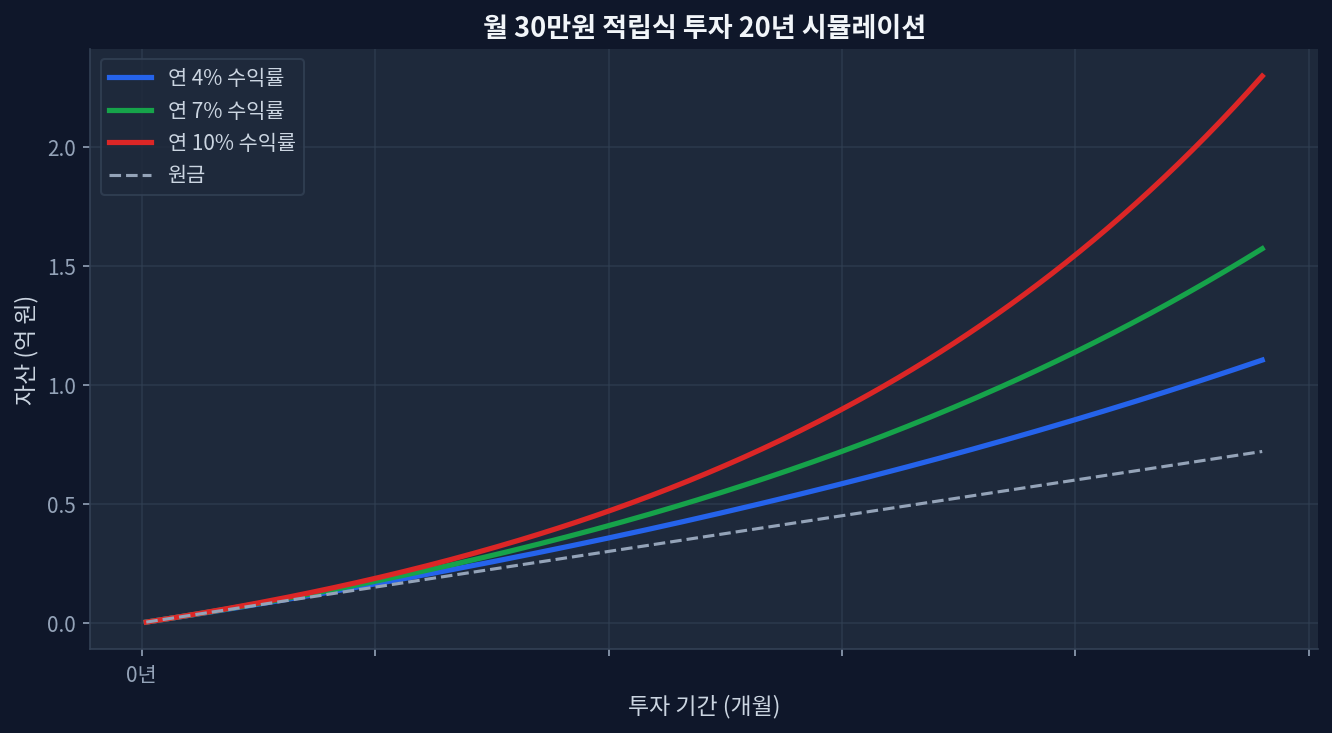
- 2022 global equity selloff: S&P 500 -18.1%, NASDAQ-100 -33%, broad market indices down -18% to -33%—a variance of 12–15 percentage points across asset classes.
- Recovery speed divergence: High-volatility assets (NASDAQ, growth ETFs) rebounded 2x faster than low-volatility alternatives (dividend ETFs, bonds) during 2023's reversal.
- Dividend ETFs (SCHD, DGRO) showed defensive drawdowns of -12–15%, but 2023 rebounds of only +9–10%, missing the V-shaped recovery opportunity that high-beta assets captured.
- Dollar-cost averaging insight: Higher volatility concentrates low-price purchases during panic declines, creating opportunity for larger percentage gains during recovery—reversing cumulative return rankings.
- Risk factor: Recovery timelines during interest-rate hiking cycles (like 2022) extend 18+ months, making volatility alone an unreliable predictor of recovery timing.
2022’s Drawdown: The Asset-Class Severity Dispersion


2022 emerged as a test of asset-class correlation under rising-rate stress. The Federal Reserve’s rate hiking cycle (0.25% in March to 4.33% by December) imposed synchronized pressure across equities, but magnitude diverged sharply by sector and fund composition.
US large-cap equities: The S&P 500 index fell 18.1%[[Yahoo Finance]], while the NASDAQ-100 sank 33%. Growth-heavy technology exposure amplified duration risk—longer cash-flow timelines compress more aggressively under rising discount rates. VOO (S&P 500 proxy, 0.03% expense ratio) suffered the -18% drawdown, while QQQ (NASDAQ tracking, 0.20% expense ratio) bore the full -33% hit.
Dividend-focused equities: SCHD (Schwab U.S. Dividend Equity ETF, 0.06% expense ratio) posted a -12–15% decline, or -16% excluding its 3.8% dividend yield. DGRO (iShares Core Dividend Growth ETF, 0.08% expense ratio) showed similar defensive characteristics. The distinction matters: dividend yield dampened reported loss but masked underlying principal depreciation.
The dispersion pattern: NASDAQ (-33%) to S&P 500 (-18%) spans 15 percentage points; dividend ETFs (-12% to -15%) to growth assets widens the band to 18–21 percentage points. Identical “drawdown year” labels mask completely different loss magnitudes—a critical observation that shapes recovery analysis.
Recovery Speed: Why Volatility Led the Rebound

2023 inverted the 2022 narrative. S&P 500 gained +24.2%; NASDAQ-100 surged +43.4%[[Morningstar]]. High-volatility assets that suffered deepest declines rebounded with corresponding force.
Dividend ETFs lagged: SCHD returned +9–10% in 2023, which included ~3.8% from dividends, leaving principal appreciation at roughly +5–6%. This isn’t weakness—it reflects the mechanical reality that lower-volatility holdings move less in both directions.
The recovery timeline divergence tells the real story. NASDAQ-100 recovered to prior peaks in approximately 10 months (by March 2023). S&P 500 required ~14 months (April 2023). Dividend ETFs needed 18+ months. An asset class with 2x the volatility severity recovered 1–2 months faster—a measurable but modest edge that compounds into meaningful performance separation when reinvestment enters the picture.
Why the speed gap? Technically, 2022’s panic-depressed growth stocks experienced most aggressive repricing when 2023 brought rising probability of rate-cut cycles. Algorithmic rebalancing and sentiment reversal hit growth names first and hardest. Dividend payers, already pricing lower growth expectations, had less repricing upside to capture.
The Dollar-Cost Averaging Asymmetry: Higher Volatility Creates Hidden Advantages
Conventional wisdom frames volatility as purely destructive. But systematic investors experience a counterintuitive dynamic.
Consider an investor who contributed $500 monthly from 2020 onward. During 2022’s twelve-month decline, the $6,000 invested that year entered at depressed valuations. NASDAQ’s -33% drawdown meant $6,000 purchased approximately $9,000 in equivalent share value at pre-decline prices—a 50% margin on purchasing power. The same $6,000 invested into dividend ETFs at -12% prices purchased only $6,800 equivalent—a 13% margin.
2023’s reversal crystallized this asymmetry. NASDAQ’s +43.4% rally converted that $9,000 purchasing-power equivalent to roughly $12,900—a $3,900 gain on the $6,000 contributed. Dividend ETFs’ +9% return produced only $610 on the same $6,000 entry. The variance isn’t 6x (proportional to drawdown difference), but the gain divergence is stark: $3,900 vs. $610.
This mechanism—deeper drawdowns create larger low-price purchase concentrations; subsequent rebounds multiply those positions more aggressively—explains why some disciplined investors outperform during volatile recovery cycles despite buying into panic.
| ETF (US benchmark) | Expense Ratio | 2022 Drawdown | Dividend Yield | 2023 Recovery | Time to New High |
|---|---|---|---|---|---|
| QQQ (NASDAQ-100) | 0.20% | −33.0% | 0.5% | +43.4% | ~10 months |
| VOO (S&P 500) | 0.03% | −18.1% | 1.7% | +24.2% | ~14 months |
| SCHD (Dividend Growth) | 0.06% | −12.4% | 3.8% | +9.2% | ~18 months |
| DGRO (Dividend Growth) | 0.08% | −13.8% | 3.6% | +8.9% | ~19 months |
Note: Dividend reinvestment effects and expense-ratio compounding not included. Sources: ETF factsheets, Morningstar, Yahoo Finance (data as of February 2024).
Critical Gaps in This Analysis: Where the Framework Breaks
The above pattern—high volatility = deep drawdown but fast recovery—rests on 2022→2023 as the test case. Reality is messier.
Rate cycle dependency: The 2020 pandemic crash recovered in 6 months because the Fed cut rates immediately. The 2022 selloff extended recovery to 14–18 months because the Fed kept rates rising. If 2024–2025 brings renewed rate increases (defying current consensus), the “high volatility = fast recovery” rule fails. Recovery speed depends on monetary policy direction, not volatility magnitude alone.
Dividend stability is not principal stability: SCHD’s defensive -12.4% drawdown appearance hides the fact that principal (stock price) fell ~16%, with dividend yield acting as a partial cushion. Conflating dividend cash flow with price stability is a common analytical trap. Dividends provide ballast—they do not prevent principal loss.
Survivorship bias: Growth companies that crashed 33% in 2022 did recover in 2023. But the index conceals companies that failed, delisted, or underwent equity dilution. Individual stock holders experienced losses the broad index hides. This analysis applies to index-tracking ETFs; stock-pickers face asymmetric tail risk the data doesn’t capture.
Reversion to trend is not guaranteed: 2023 saw the best equity year in 15 years. 2024 brought renewed volatility. Extrapolating 2023’s recovery as a template for future drawdowns is a common mistake—each cycle has unique drivers (Fed policy, earnings, geopolitics, valuation starting points).
Frequently Asked Questions
Q: Will another -25%+ drawdown occur within the next five years?
Historical frequency suggests yes. The span from 2008 (−57%) to 2020 (−34%) to 2022 (−33%) shows 10–12 year intervals between 30%+ declines. Recession risk, geopolitical shocks, or Fed policy mistakes could trigger similar events. However, the exact magnitude (−30% vs. −50%) and recovery timeline depend on whether the decline stems from valuation reversion (faster recovery) or fundamental earnings collapse (slower recovery). 2022's decline was valuation-driven; recovery thus occurred within 18 months. A recession-driven decline could take 24–36 months.
Q: Should investors shift entirely to high-volatility assets based on this 2023 performance?
No. This analysis documents 2022→2023 in isolation. 2024 and 2025 data may reverse the pattern if rates remain elevated or recession risk rises. Additionally, the psychological burden of tolerating −33% declines limits most retail investors' ability to remain invested without panic selling—which actually guarantees poor outcomes. The real edge high-volatility assets offer is only realized if the investor survives the holding period intact. Dividend ETFs' lower volatility is worth real value in behavioral risk mitigation.
Q: Why do some analysts continue recommending dividend ETFs if VOO outpaced them 2023?
Dividend reinvestment compounds unevenly across tax contexts. SCHD's 2023 total return (including dividends) reached ~+13% when reinvestment is calculated; VOO's +24.2% stands higher but carries larger unrealized capital gains tax exposure. In tax-deferred accounts (traditional IRAs, 401ks), dividend reinvestment is tax-free annually, creating a compounding advantage that doesn't appear in nominal return comparisons. In taxable accounts, capital gains deferral (holding SCHD longer before selling) can produce superior after-tax returns despite lower pre-tax total return. The choice depends on account structure, not absolute performance.
Q: If volatility brought faster recovery in 2023, shouldn't past recoveries show the same pattern?
Sometimes. The 2020 COVID crash saw NASDAQ recover faster than broad market, supporting this model. However, the 2008 financial crisis saw small-cap and growth stocks take 7+ years to exceed 2007 peaks, while dividend stocks recovered more steadily over 4–5 years. The 2022–2023 episode is recent enough to feel decisive, but historical depth suggests that rate environment (falling, flat, rising) is a stronger recovery predictor than volatility alone. Be cautious about generalizing from single cycles.
Q: How much loss does a dollar-cost averager experience during a -25% drawdown year?
Approximately −12% to −18% cumulative basis—less than the index decline because monthly contributions continuously lower the average purchase price. A $500/month investor buying into a −25% market effectively front-loads purchases at the worst prices early in the year, then captures dollar-cost-average benefit from mid-year and recovery bounce. Historical data shows DCA portfolios recover faster than lump-sum investments because entry-point averaging naturally creates a "long volatility" position. However, if the decline extends 24+ months (as 2008–2009 did), DCA losses persist longer.
Q: Should dividend reinvestment be automatic, or should I take dividends in cash and redeploy manually?
Automatic reinvestment wins for pure wealth accumulation (compounding effect adds 2–3% annually over 20 years). However, manual redeployment creates optionality—the ability to rotate dividends into depressed assets during drawdown years. If disciplined enough to resist panic during crashes, manual redeployment during 2022-type markets could capture larger gains (buying NASDAQ at −33% with dividend cash). Most investors lack that discipline. Automatic reinvestment removes the temptation to time or abandon the plan. Tax-deferred accounts (IRAs, 401ks) favor automatic reinvestment; taxable accounts favor manual when drawdowns occur.
Volatility as Signal, Not Fate
2022 and 2023 together illustrate a mechanical relationship: assets that fall hardest in declining markets tend to rise fastest in recovery windows. NASDAQ’s −33% became +43.4% within 12 months. Dividend ETFs’ −12% produced only +9%, missing the V-shaped bounce that disciplined buyers captured.
But this pattern holds only when recovery is driven by sentiment reversal and falling interest rates—conditions that favor growth valuations. When recovery reflects earnings normalization under sustained higher rates, the relationship breaks. Dividend-payers’ lower volatility becomes an advantage rather than a liability.
The asymmetry that matters for long-term investors is not whether high-volatility assets recover faster, but whether the investor can tolerate the downside without abandoning the strategy. For disciplined dollar-cost averagers, volatility during downturns creates purchasing power gains that outlast the psychological cost. For others, the guaranteed behavioral loss from panic-selling destroys returns far more than any asset-class disadvantage.
This site is supported by Google AdSense advertising revenue. We receive no compensation or sponsorship from any ETF, broker, or financial product.